

Why do battery companies crowdfund?
a different approach to capital

Issy chats to Altilium, the UK battery recycling company, to understand why some battery companies might crowdfund.
This content is for interest and informational purposes only and should not be considered investment advice. Through this website, Intercalation Collective does not provide any investment, legal, accounting, or tax advice.
One of the corner stones of the battery industry that we devote less words to in this newsletter is finance. It is the make or break of battery companies as frequently as the actual technology. The dominance of Chinese battery companies is often attributed in part to near-zero interest loans from local government, which allowed companies to build out capabilities while profits remained extremely low.
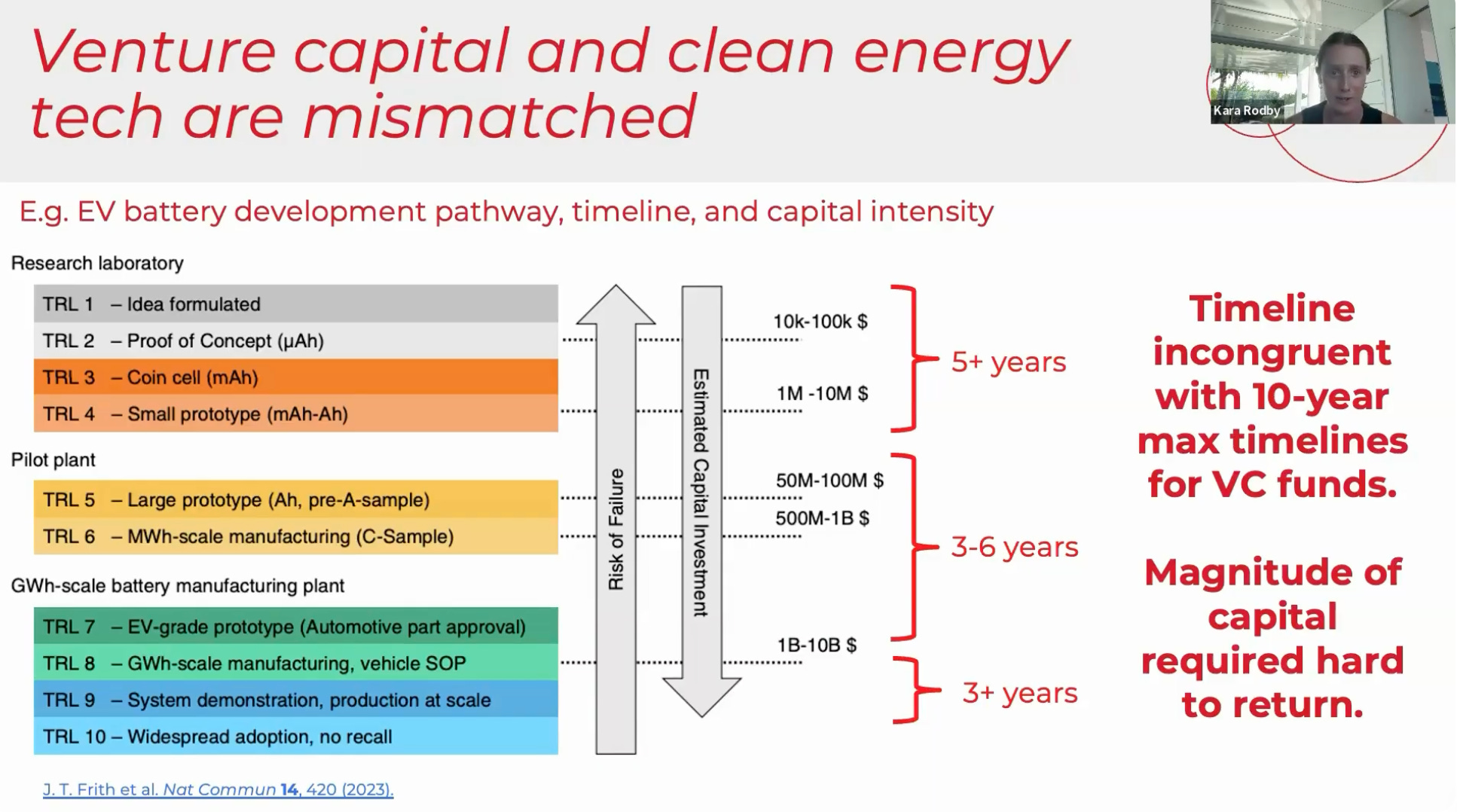
In the USA and Europe, companies raise money largely from venture capital, debt financing (like a mortgage on a house) and from governments via grants, subsidies and loans. Venture capital funds normally operate on 10 year cycles, returning the capital back to investors within that period. That’s simply not possible if it’s locked into a battery factory somewhere, while the profit very slowly accumulates on a production line.
The fundamental mismatch between venture capital and clean tech like batteries was well summed up in this recent talk by Kara Rodby at the Volta Foundation. Batteries are a low margin industry, where low interest, patient financing options are crucial. Capital expecting a return in less than 10 years simply won’t be satisfied.
There’s one form of ‘long term, patient capital’ which is seen less regularly in the battery space. This is ‘crowdfunding’ or ‘retail investors’, individuals who invest their own savings in ventures they believe in or belive will have a high return. A few companies have raised from crowdfunding sources over the last few years, and there are two different types where you can either essentially ‘preorder’ a product, confirming market before launch, or a more traditional model where you get to hold equity of the company, like a stock.
Examples of equity crowdfunding in the battery space include:
Soteria raised $433,486 (USD) from 333 investors in 2023.
Minviro, who raised £807,726 from 188 investors in 2025 to scale their LCA platform XYCLE.
Recyclus raised £63,592 from 191 investors in 2026, for additional processing equipment designed to further optimise recycled material outputs.
Cornish Lithium have raised several multi million pound rounds from 2019 to 2025.
Crowdfunding seems to offer several advantages, notably that the investment pool is much wider than just traditional venture capital and may include expertise or networks. It also allows companies to build strong presence in communities where they operate, which is particualrly important in companies that need planning permission and good local relationships, like mining or heavy industry. It could however also signal that companies were unable to raise from traditional investors, or that they need an instant available injection of cash without revaluing the company by doing a full funding round.
There was only one way to get more insights into this model, and that was to get on the phone to someone who has done it. In the UK one battery recycling company is crowdfunding again, following a £6,608,804 round with 762 investors, so naturally that was exactly who we called. We last spoke to Altilium at the end of 2024, so it was fantastic to catch up with Dr Christian Marston on all things crowdfunding.
Altilium is currently planning to get spades in the ground for their scale up ACT3 facility in the south west of the UK this summer. Once complete, ACT3 will process 24,000 EV batteries per year into nickel mixed hydroxide precipitate, lithium sulphate and graphite, a pretty big step up from their pilot line ACT2 facility. ACT3 will be proof of concept for a much bigger plant that would process 150,000 EV batteries a year in Teesside.
What is Altilium’s experience of the funding landscape?
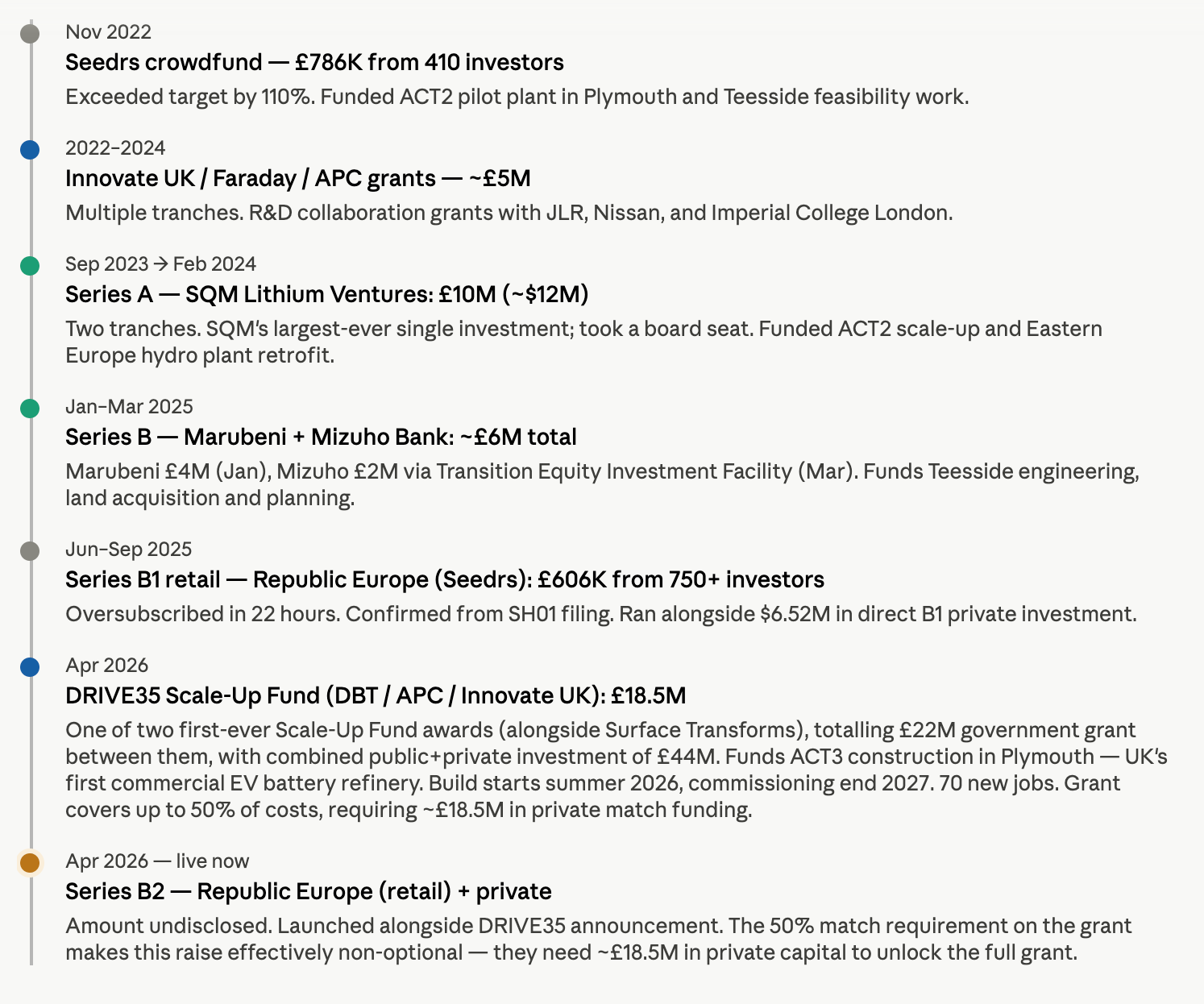
We’re very proud of SQM, Mizuho and Marubeni. They think strategically as patient long term capital. It’s not that we have a traditional VC like the generic decarbonization fund VCs. We actually really struggled with traditional VCs in the early days. They would say we really liked the tech and then when we say, look, we’ve got to build facilities and get spades in the ground and they lost interest. So we’ve been fortunate with strategic investors from the industry that understand this industry.
So… crowdfunding. How does it work?
The first point is that you have to engage with the platform like Republic. One advantage of crowdfunding in the early days is it gives you credibility because retail is FSA regulated and there’s a lot of due diligence and compliance checks. You’ve got to convince the crowdfunding platform that you’re a credible business. You sit on their platform and they can send out emails to their investors, increasing your profile.
For a couple of weeks you’re engaging with companies which are registered or have an interest, and then there’s a priority period for normally a week, and then it’s open for a month. Through that month, you can engage with the people who haven’t invested on your list. When you’ve done it two or three times you have your existing investors already. We have a over 1,000 retail investors, who own 0.5% via one special purpose vehicle.
Altilium also just secured an £18.5 million UK grant for their ACT3 plant in Plymouth, from the UK Government’s Drive35 Scale Up programme to support zero-emission vehicle technologies. The conditions of this grant (minimum 2:1 private investment:grant ratio) imply that Altlilium needs both £37+ million of commited private investment and some cash headroom.
How does the crowdfunding interact with the rest of your grants and investments?
We have SQM as a shareholder in our Series A, the world’s largest lithium supplier, and then in 2024 we had Marubeni and Mizuho bank, large Japanese corporates. So I think importantly, they’re patient long term capital. Our pilots are running and we’re producing materials, which we’re qualifying for the ACT3 facility. We’ve started planning and permitting, and we have the 18.5 million pound grant to scale up.
The reason we crowdfunded was firstly to build on that momentum. As a concept the reason to crowdfund is the community aspect. We really want to engage with the community where we’re investing, because we have public consultations on planning and environment permitting on our facility.
Having institutional and retail investors allows us to understand how we present this business. The questions we get asked are quite interesting. It really allows us to sharpen how we built this company and present this opportunity. It could be that one day Altilium does an IPO and having some early engagement with retail investors means we have some governance. The Republic platform is not like being listed, but we do have to give quarterly reports and we answer questions.
One of the challenges of getting to Net Zero is you’ve got to build infrastructure and with plants and giga factories, the capexes are high. You can’t build a plant with crowd funding money. So it’s less about the the money. The energy transition requires kind of an enormous amount of capital and and bringing the public into that journey gives some momentum and support to recovering critical minerals from old EVs. As we move forward and we do a series C and a series D, we will continue to engage with our early investors who put money in from day one and it allows them an opportunity to continue to invest and to think about Net Zero.
What are the main motivations for crowdfunding?
Battery recycling is still invisible to the public generally, and it’s really critical to the EV transition. For the public awareness of EV batteries in the energy transition and the myth that they can’t be recycled, we think crowdfunding is one way to increase the profile of battery recycling.
Having a long term supporter base around the company is good as well. Investors have become advocates, they follow the technology, share the story, amplify awareness around battery recycling and circular economy. These are local people and more broadly within the UK. People invested from the battery industry and we were very proud that they invested, and we’ve even been able to engage with them, and they’ve helped us with advice.
Anyone who talks about Net Zero and doesn’t have fluency of Lithium supply chains or around critical minerals, probably doesn’t know how you’re gonna get to Net Zero. It’s hard if you’re an individual, how do you support getting to Net Zero? You recycle your rubbish, you think you’re doing a good thing and you are, but it could be a distraction. There’s not much you can do as an individual to get to net zero. You can eat less with meat, fly less, drive an EV and maybe start a clean tech company. This is one way we can let people make an impact, you can hold two stocks in Altilium. If you’re interested in Net Zero or industrial resilience it is a platform to to support getting there, and we want to give people that opportunity.
The night train service European Sleeper aimed to raise €2.3 million to finance an expansion of services, including the cancelled Paris-Berlin connection. If you believe the internet forums, many of the investors in that particular venture were believers in the project of providing better European night train infrastructure, rather than people trying to explicitly make a profitable return. Critical minerals are also critical infrastructure and structural necessity to the economy, something Ed Conway has been talking about a lot recently as factories shut down in the UK due to high energy costs, leaving the country reliant on imports for crucial building block chemicals.
Do you think the retail investors in Altilium are hoping to make money or do they see this as important critical infrastructure where they can contribute?
I think it’s dual. They want to make money, and I think they’re generally interested in net zero and clean tech. We are asked questions “How are you going to make money, what’s the exit? Are you going to do an IPO? Is it going to be a trade sale?” So I don’t think it’s purely altruistic, I think they are expecting a return and as a commercial company we expect a return to our investors.
In terms of making money as a company, we were set up to support Net Zero and industrial resilience and recovering critical minerals from existing waste streams such as EV batteries, onshorering supply chains here. We just keep building and hitting milestones. I think if we do this right, we make money. But the purpose of doing this isn’t just to make money.
How does the recycling market feel in general at the moment?
There’s a bit of fatigue around Net Zero, and there’s an opportunity for this industry to reduce dependence on oil and overseas raw material, that sovereign piece is important. The market might get tight for secondary raw materials, as you move later this decade because of the regulatory requirement for recycled material.
The geopolitics as well since President Trump made critical minerals more high profile, the politics of localised supply chains and not being reliant on others. We see that what's happening in the Middle East as well. I think it supports the narrative of a number of UK companies in critical minerals and batteries.
What’s on your mind, looking forward to your next round of crowdfunding?
I think sometimes people see crowdfunding as something a company does really early on and then you don’t need to do it again. That is probably applicable to some industries, but we’re building strategic industry for the UK. I think you will see companies in critical minerals as we move forward will use some retail investment for community and increasing profile.
Thanks again to Altilium for talking to us!
🌞 Thanks for reading!
📧 For tips, feedback, or inquiries - reach out
📣 For newsletter sponsorships - click here
🌐 Follow us on Twitter, LinkedIn, and our website
Investing in start-ups and early-stage businesses involves risks, including illiquidity, lack of dividends, loss of investment and dilution, and it should be done only as part of a diversified portfolio. Intercalation Collective is targeted exclusively at investors who are sufficiently sophisticated to understand these risks and make their own investment decisions. You will only be able to invest via Intercalation Collective once you are registered as sufficiently sophisticated. This content is for informational purposes only and should not be considered investment advice.
Through this website, Intercalation Collective does not provide any investment, legal, accounting, or tax advice, but provides intermediary services between investors and startups and acts as an access facilitator to an investment syndicate. The information provided should not be considered suitable for the personal situation of each investor and the investment schemes, securities, or services offered are not necessarily adapted, suitable and individualized to each investor.
Intercalation Collective provides its services as an access facilitator to an investment syndicate. The services are provided through third-party Platforms such as Vauban or Odin. When using the services, you acknowledge and accept the terms and conditions as well as the privacy policy of these Platforms. Intercalation Collective does not provide any warranty for the services of these Platforms and assumes no liability in this regard. If you do not wish to use third-party Platforms like Vauban or Odin, please contact us so that we can work on an alternative solution. As an investor in the syndicate, you commit to ensuring that no breach of any laws, regulations, code of practice or guidelines applicable to them, occurs in connection with the operation of the investment. Prior to any investment sought independent legal, tax or regulatory advice in relation to those jurisdictions it considers appropriate, as Intercalation Collective’s services do not include legal, tax or regulatory advice. In this regard and to the extent permitted by law, Intercalation Collective cannot be held liable for any loss or damage whatsoever.
The information on and the materials accessible through this website and third-party Platforms like Vauban or Odin should not be considered by visitors as an alternative for the exercise of their own judgment; a careful analysis is necessary, and it is recommended to potential investors, before making any investment decision, always to consult a qualified professional advisor to obtain appropriate advises, in particular financial, legal, accounting or tax.