

Can we build predictive (quantitative) solid state battery models?

Today Ankit Verma takes a crack at explaining why we haven’t got any good solid state models yet, and what can be done to move the field closer to its own solid state equivalent of the DFN.
Lithium metal solid-state batteries (SSBs) have been heralded as the prodigal successor to lithium-ion battery (LIB) technology since the 1970s but are yet to take the world by storm. Famously, every decade since then, they are consistently positioned as a technology that is still a decade away.
Plenty of treatises have documented experimental progress in solid state batteries: solid electrolytes (SEs) with favorable electro-chemo-mechanical properties; manufacturing thin Li metal and defect-free separators etc. pushing them towards commercial viability. Alongside, physics-based models that can guide experimental SSB design (aka continuum models) through rigorous validation and predictive insights, have been developed since the 2000s but haven’t always stood the test of time. This is in sharp contrast to something like the pseudo-2D Doyle-Fuller-Newman (DFN) model developed in 1993 that still serves as the most useful predictive electrode optimization model for lithium-ion batteries (LIBs). A well parameterized DFN model or its kiddie equivalents like single particle model provide a wealth of knobs for beginning of life and lately, cycle life optimization, for higher energy/power density while minimizing degradation. Li-ion P2D models are available commercially in GT-AutoLion, COMSOL, ANSYS, MATLAB etc. and the development of the open source software PyBaMM has been leveraged by startups like Ionworks for accelerated cell design optimization.

So, what’s the hold up in solid state battery models? The big challenge is mechanics, a whole new dragon that needs to be tamed alongside electrochemistry. The liquid electrolyte Li-ion DFN model can be modeled as coupled species, charge and thermal transport partial differential equations (PDEs) on a fixed mesh with closure relations provided by thermodynamics and kinetics. As we move from the liquid to a solid medium and swap small volume expansion intercalation electrodes in Li-ion (e.g. graphite) with high volume expansion Li metal plating/stripping in SSBs; stress fields, moving interfaces, point contacts, crack propagation etc. add humongous complexity to this relatively benign model. This requires moving-mesh techniques alongside unraveling the impact of stress on each of the existing field variables (concentration, potential, temperature). There have been attempts to tackle this problem, with varying degrees of success. Let’s walk through some of these models starting off with a focus on the Li metal|separator side of things (1-3), then focusing on composite solid state cathode microstructure models (4) and then finally bringing it all together for a DFN equivalent for a Li metal SSB (5).
1. Deposition Stability models: Kinetics is King
Monroe-Newman (M-N) (yes, the same Newman from DFN model for LIBs fame) first gave a stability model, circa 2004/’05, on deposition stability at the Li metal - SE interface incorporating how mechanics induced stress alters the interfacial electrochemical potential (e⁻) and provided a formalism for updated Butler-Volmer reactions kinetics at the Li-SE interface (see figure below: the additional exponential term shaded in blue). Model assumptions involved include elastic mechanics and perfect contact. It’s a tour de force theoretical work, deriving complex thermodynamics-mechanics-kinetics relationships that distills the kinetics impact into a simple equation that can be readily implemented in electrochemical models based on molar volumes (V), interfacial shear stress (τd) and interfacial hydrostatic stress (also known as pressure, p).
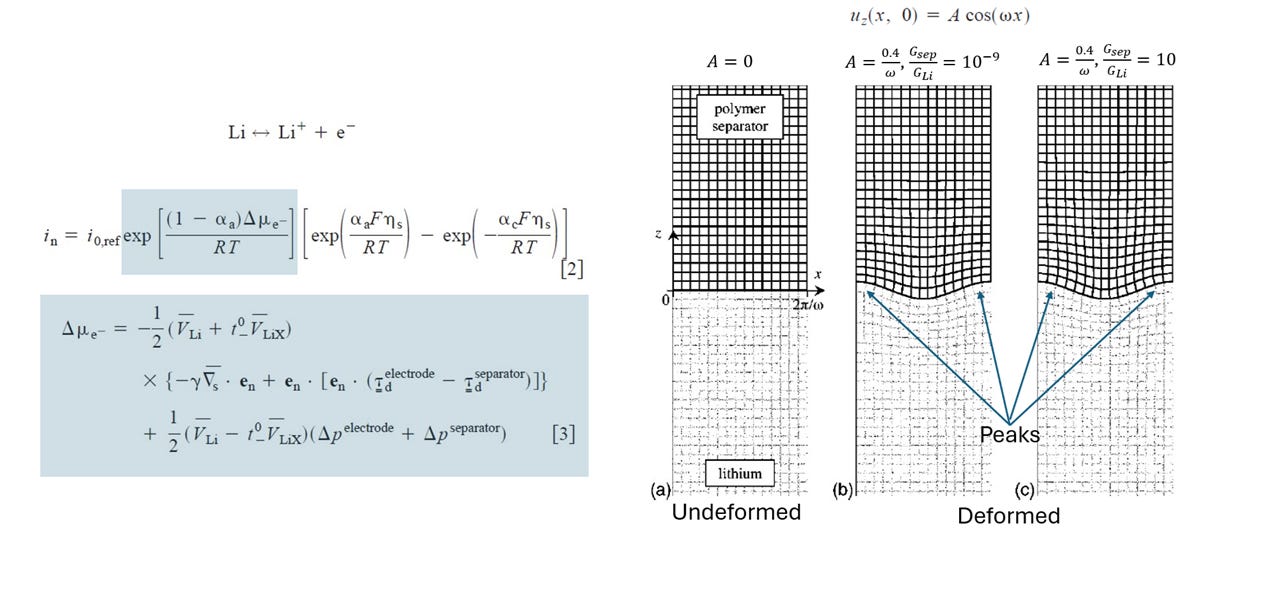
Using this, the paper argued that with appropriate SE material properties, current density at lithium domain peaks can be manipulated to be lower than the current density in the surrounding areas (for stable deposition) resulting in one of the biggest unfulfilled prophecies in solid state battery modeling literature:
“For a polymer material with Poisson’s ratio similar to poly(ethylene oxide), interfacial roughening is mechanically suppressed when the separator shear modulus is about twice that of lithium ”.
That is, as long as the shear modulus of the SE separator is twice that of Li metal:
then stable deposition is achieved.
Experimental observations have shown this to be incorrect, and the dendrite propagation problem persists. Over the past 20 years, different versions of this model have come out. Researchers have enhanced the mechanics complexity adding plasticity, creep for Li metal, etc. (with conformal contact) while focusing on the stress impact on Li kinetics at the interface. Experimentally, Li metal still penetrates through the separator for all known SEs and causes shorting; whether it’s polymer electrolytes that are soft, ceramic electrolytes that are stiff, sulfide electrolytes that are in-between or any concoctions of hybrid/new electrolytes researchers are cooking. Death by Li penetration is one of the cardinal truths of Li metal SSBs.
A widely known aphorism goes, “All models are wrong, but some are useful”. It can be safely concluded that papers that directly use the elastic limit M-N correlations can be binned under the “these models are wrong and minimally useful” category, especially when it comes to providing any predictive insights. Furthermore, stresses at the interface need to be at the 100s of MPa levels for the mechanics impact on kinetics to be substantial. For commercial solid state battery systems that are aimed to be operated under low stack pressure ~1 MPa, and bulk Li metal yielding around similar values, it is unlikely that interfacial stresses would ever go beyond 10s of MPa even with stress localization at contacts.
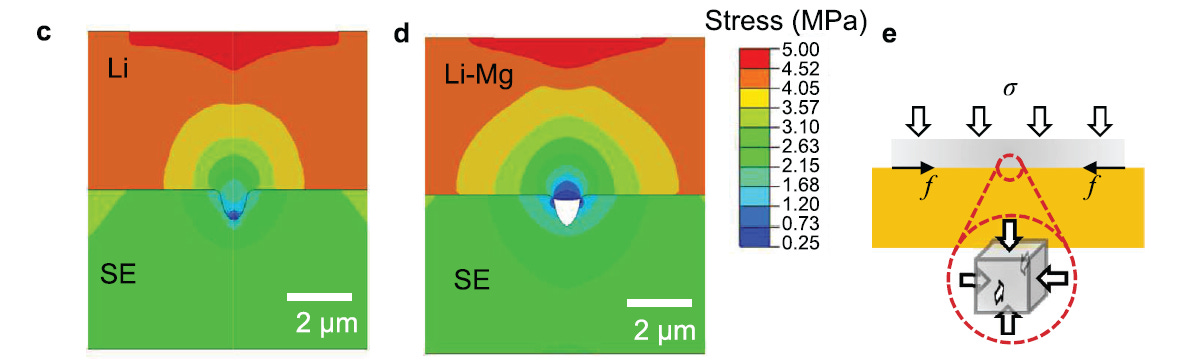
Models incorporating complex Li metal mechanics (plasticity, creep) are truly commendable in their ambition to provide phase maps for deposition stability regimes as a function of mechanical properties. However, most of them use perfect interfacial contact as the inherent assumption which is incomplete. An intuitive answer for the inaccuracy is the disproportionate focus on stress-based reaction kinetics as opposed to contact loss dynamics.
2. Deposition Stability models: Contact is Crucial

Starting in the 2020s, solid-solid contacts and contact area loss models have been explored as the mechanism for current focusing and dendrite growth. This emulates the presence of surface roughness and defects which reflects the true nature of solid-solid contact. The first such paper by Steve Harris and coauthors suggested: “Preferred stack pressure be at least 20 MPa to maintain a relatively small interface resistance while reducing void volume for LLZO type electrolyte”. The gap between lithium and SE (gLi-se, correlates to contact) is computed considering Li elastoplastic deformation (uLi), roughness of both surfaces (sequiv), Li surface morphology evolution due to plating/stripping (hp/s-Li), Li creep (hcreep-Li) and relative rigid body motion between Li electrode and SE (δLi-se)

This is a step in the right direction, but experimental literature reports a wide variation in stack pressure magnitudes needed to reliably cycle the cells. Plus, there is an interesting mechanism at high pressure where Li metal can flow around the sides and short the cell alongside other issues of pressure induced material fracture and dendrite growth.
3. Li-Li Symmetric Cell Models
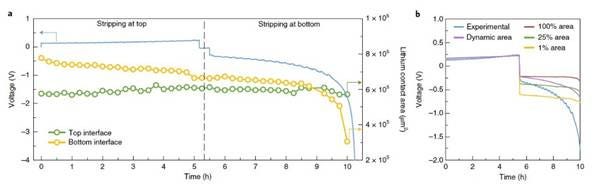
Symmetric cells are the basic experimental configuration that are used to understand Li metal-separator stability through critical current density measurements. Prima-facie, it’s a simple system where if we can model contact evolution and separator resistance, we should be able to predict the voltage through the test and when the cell will fail. Things get complicated because interphase growth happens even if there is no contact loss at high pressures. Plus, SEs are never completely devoid of voids and Li can penetrate through the grain boundaries and voids. For example, researchers have experimentally tracked the interface area evolution at plating/stripping Li|separator interfaces alongside voltage. Incorporating the area dynamics in a symmetric cell model allowed validation of the charge voltage evolution but significant deviation between model and experiments is observed in the discharge segment indicating other processes at play.
4. Microstructure Models for Effective Property Calculation of Composite Cathodes
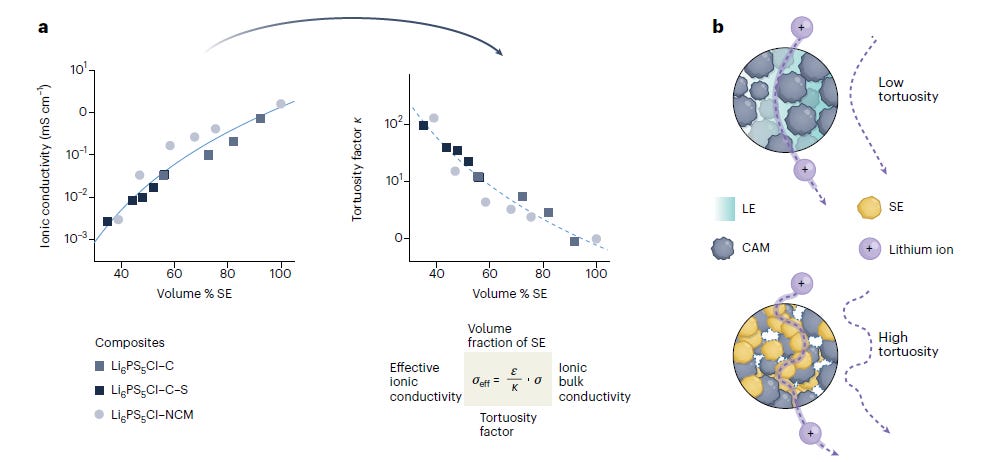
Peering into the 3D arrangement of the cathode active material (CAM) and SE particle alongside conductive additive and binder (CBD) can reveal composite solid state cathode limitations. Researchers obtain this microstructure through two methods: imaging or virtual generation. However, realistic 3D microstructure visualization is a challenge for solid state battery cathodes as imaging is not generally done under any stack pressure. Also, the resolution needed to resolve point-to-point CAM-CAM, CAM-SE, SE-SE, CAM-CBD contacts is high. Intuitively, solid state cathode (SSC) performance is primarily dictated by contacts. A Li+ ion hopping through the SE phase (e.g. LPSC) in the cathode will preferentially move through the contact points between consecutive LPSC particles. Whereas, in the liquid electrolyte equivalent, the ions can freely move through the bulk as the electrolyte wets all solids and forms a percolating network.
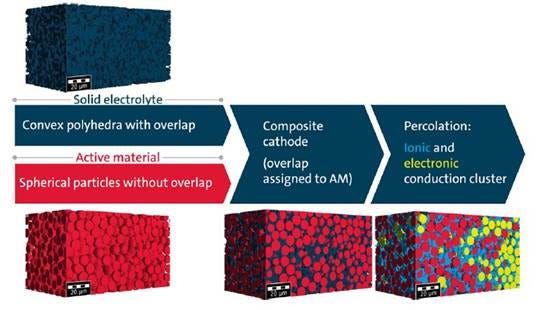
The second approach: virtual generation of microstructure, is idealistic, but it has helped bring the liquid electrolyte Li-ion understanding to the next level using homogenization calculations to probe effective cathode properties like tortuosity and electronic conductivity. Softwares like MATBOX etc. can be leveraged to quantify these relations and architectures can be optimized computationally to improve these properties. However, they provide over-optimistic predictions for SSC properties as compared to experiments because of the same contact resolution challenges. Point-to-point contact in SSCs requires inclusion of additional contact resistance at each interface. Experimental liquid electrolyte cathode ionic tortuosities generally lie <10 and match model prediction. While SSC experimental tortuosities can reach 100, with standard homogenization calculations underpredicting it. As such, conflicting insights like smaller cathode particles vs larger cathode particles being optimal are prevalent in the solid-state modeling literature.
5. Li|Separator|NMC full cell models: The DFN equivalent.
All above models combine to form the equivalent of P2D model for solid state batteries. But it’s rare to see such validated models in literature, especially at current rates beyond 1C. In addition to the complexities in above sub-models, cathode particles also expand/shrink when Li is inserted/extracted causing imperfect contact in the cathode to evolve during discharge/charge. So, the single dynamic interface at the Li metal-separator interface combines with thousands of dynamic interfaces in the solid-state cathode for a single charge or discharge. The complexity gets magnified exponentially.
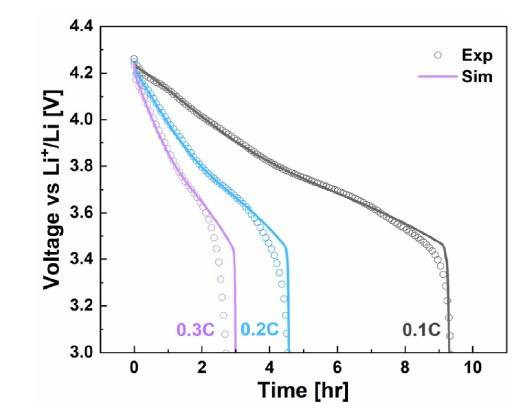
The above limitations should both worry and excite researchers getting into solid state battery modeling research.
Here’s the solution to this challenge in my opinion:
1. Balancing acts between simple and complex models:
A quote attributed to Einstein goes: “A model should be made simple, not simpler”. My interpretation of this statement is “build as simple a model as you possibly can that can accurately quantify a phenomenon and be of predictive use”. In the solid-state realm, we directly started off with the complex M-N model as the baseline. For over 20 years since the M-N model came out in 2005, researchers (including yours truly) have been using stress modified Butler-Volmer kinetics in solid-state models (the article has over 2000 citations!). Nobody stopped to ask: did the M-N modification provide better accuracy in experimental Butler-Volmer rate kinetics data validation with the addition of stress based exponential term as compared to without it? To this date, experimental proof is lacking. No targeted experiments to evaluate Butler-Volmer kinetics as a function of stress at the Li metal/separator interface are available in literature that we can find. In addition to kinetics, researchers have proposed new theories for stress affecting electrochemistry: e.g. stress affects open circuit potential (OCP), stress affects Li+ diffusivity in the electrolyte. While some fundamental experiments have been done in this realm e.g. from Paul Albertus’ group that tracks how interface stress affects OCP, more is desperately needed to quantitatively validate the theories.
In retrospect, starting with a simple model, and slowly adding complexity as needed is a viable alternative. Complex models add more physics but also add more tunable parameters. (Not limited to just solid-state battery models). A model should not be made infinitely complex. And in the solid-state battery realm with coupled electrochemistry-transport-mechanics, it is already reaching the upper echelons of complexity. A case could be made to brute force the SSB experimentally with simple models providing quantitative insights, instead of relying on overcomplicated models that try to bring all aspects together while providing inconsequential qualitative insights.
2. Stop copying LIB microstructure models blindly.
While experimental solid-state cathode testing has limped to reproducible electrochemical data in the past decade, modeling works incorporating virtual cathode microstructure generation models and image-based generation filled the gap and have been Ctrl c- Ctrl v’d from the LIB realm. Nuances on imperfect contact between particles have often been glossed over. Microstructure based homogenization calculations of effective electronic/ionic conductivities need to be coupled with experimental measurements of the same for proof. Furthermore, imaging that resolves particle-particle contact and tracks the interface accurately under pressure should be conducted before moving towards image-based models.
3. Melding models with standardised, intelligent experiments
Recently, a lot of emphasis has been placed on reproducibility of solid-state electrochemical data. Lithium-ion cell testing has provided reliable electrochemical data with small error bars for decades now. This standardized fixturing and testing should pervade the solid-state battery community to generate good quantitative data for models to validate against.
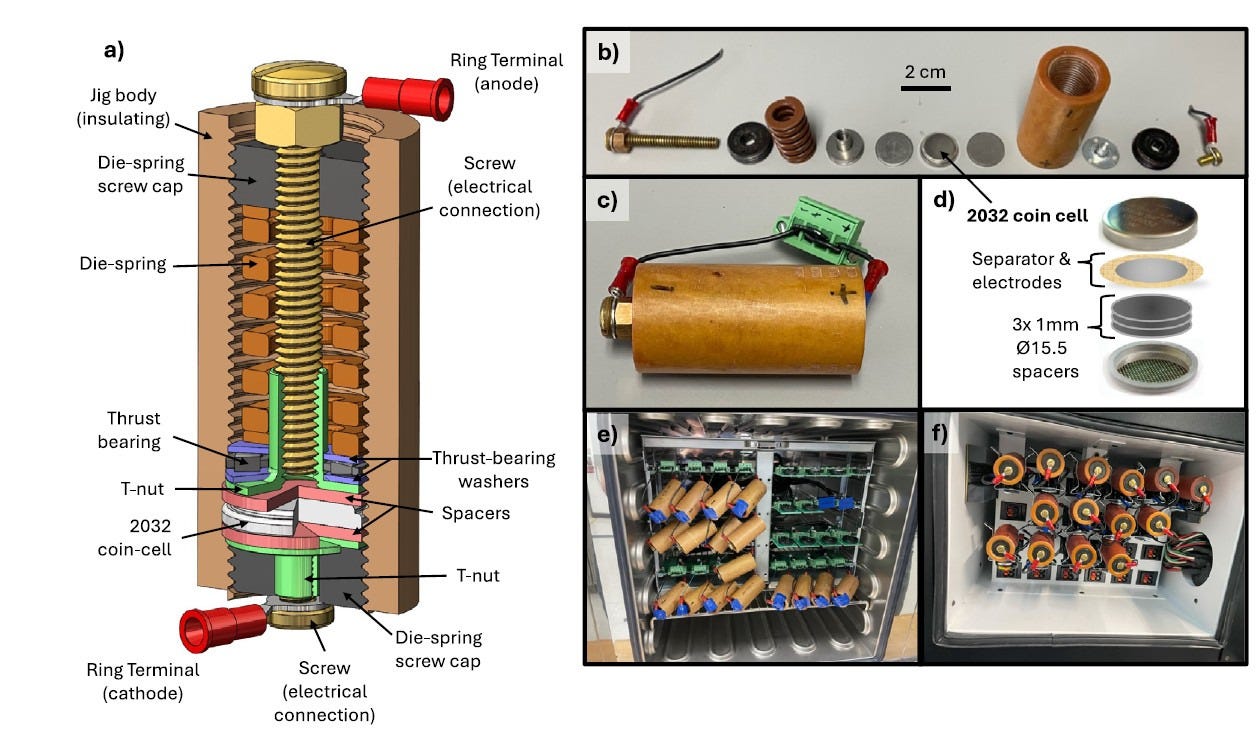
Additionally, intelligent electrochemical couples can be paired to isolate electrochemical phenomena at the anode/cathode/separator. Use Li-In (lithium-indium) on both sides if you want to quantify the SE bulk as interfaces will be good. Use Li-In on one side and Li metal on the other to quantify what’s happening at the Li metal interface. Use Li-In full cells to explore what’s happening in the cathode. If grain boundaries are an issue, use an amorphous separator. And so on and so forth.
I will leave the reader with some useful reads for solid state continuum model reviews:
Feel free to provide comments on this assessment. And keep an eye out for some solid state works in the symmetric cell and full cell paradigm tackling these challenges.
🌞 Thanks for reading!
📧 For tips, feedback, or inquiries - reach out
📣 For newsletter sponsorships - click here